

LS vs Coyote vs HEMI: Real-World Power & Cost Breakdown
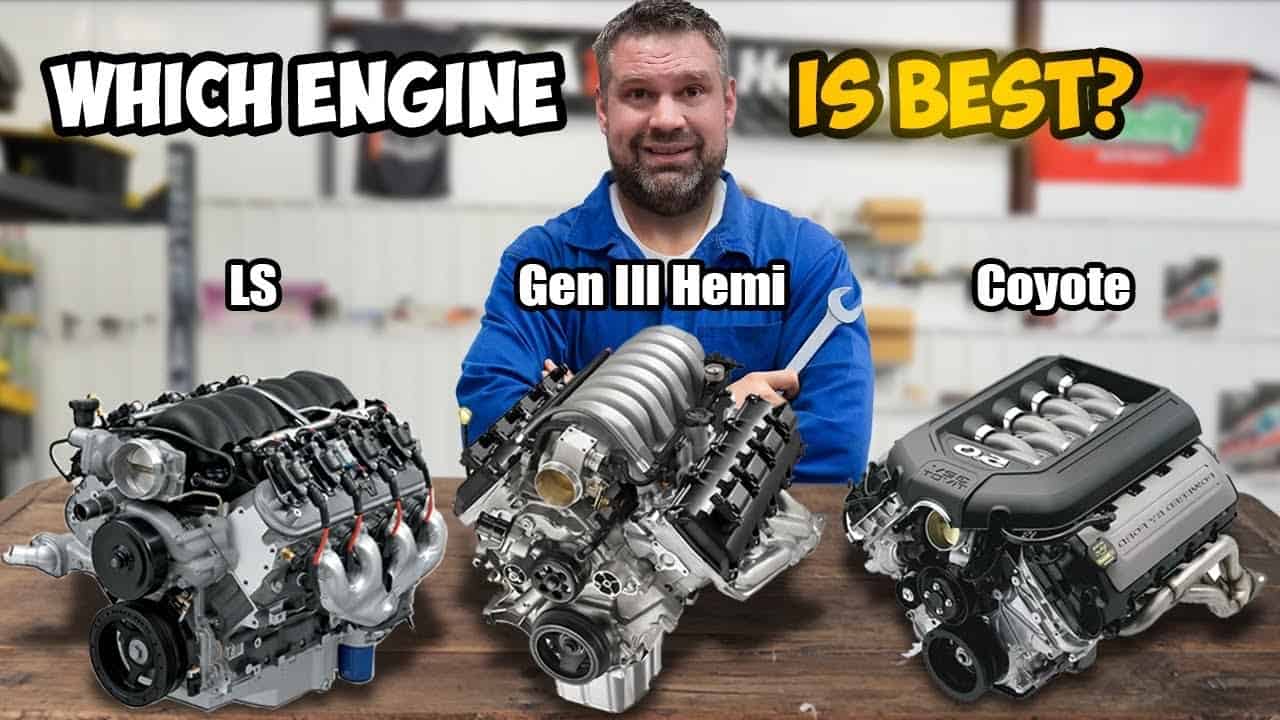
![Three modern American V8 engines displayed side by side: GM LS, Ford Coyote, and Dodge Gen III HEMI]
Caption: The Big Three’s modern V8 offerings each take a different engineering approach, resulting in distinct personalities, costs, and swap considerations.
The debate has raged in garage forums and at car shows for nearly two decades: which modern American V8 is the best? The answer, frustratingly, is “it depends.” GM’s LS engine family, Ford’s Coyote, and Dodge’s Gen III HEMI each bring unique strengths to the table, and the right choice depends entirely on your project goals, budget, and personal preferences.
This comprehensive LS vs Coyote vs HEMI comparison cuts through the fanboy rhetoric to deliver real-world data on power potential, costs, physical dimensions, reliability, and swap complexity. Whether you’re building a budget hot rod, a track-day weapon, or a show-stopping resto-mod, we’ll help you make an informed decision.
The Contenders: A Quick Overview
| Engine Family | Displacement | Configuration | Valvetrain | Block Material | Weight | First Introduced |
|---|---|---|---|---|---|---|
| GM LS | 4.8L – 7.0L | 90° V8 | Pushrod (2V) | Iron or Aluminum | 380-475 lbs | 1997 |
| Ford Coyote | 5.0L – 5.2L | 90° V8 | DOHC (4V) | Aluminum | 430-445 lbs | 2011 |
| Gen III HEMI | 5.7L – 6.4L | 90° V8 | Pushrod (2V) | Iron | 500-560 lbs | 2003 |
Power & Performance Characteristics
Horsepower & Torque Curves
![Dyno graph overlay showing torque curves of LS, Coyote, and HEMI engines]
Caption: The LS delivers its torque low and flat like a plateau; the Coyote builds power with RPM; the HEMI splits the difference with strong low-end punch.
The engineering philosophies behind these engines result in dramatically different driving experiences .
GM LS: The Torque King
The LS’s pushrod design and large displacement create massive low-end torque. A stock 6.0L LQ4 makes approximately 360 lb-ft of torque at just 4,000 RPM, with over 90% of that available from 2,500 RPM upward. This translates to effortless acceleration from a stop and makes LS-powered vehicles feel significantly stronger than their horsepower numbers suggest. The broad, flat torque curve is often compared to “Devil’s Tower in Wyoming”—massive and immediately present .
Ford Coyote: The High-Revving Power Density Champion
The Coyote’s DOHC, four-valve architecture allows it to breathe exceptionally well at high RPM. While a 5.0L Coyote makes similar peak horsepower to a 6.0L LS, it achieves that power through higher engine speeds rather than brute displacement. This results in a engine that loves to rev and builds power progressively as the tach climbs. However, some enthusiasts find the Coyote feels “mundane around town” compared to pushrod engines, with noticeably less low-end torque despite impressive peak numbers . The trade-off is exceptional power density—Ford achieves LS3-level power from a liter less displacement .
Gen III HEMI: The Best of Both Worlds?
The HEMI’s hemispherical combustion chambers and cross-flow head design create excellent airflow characteristics with large valves positioned on opposite sides of the chamber . This allows the HEMI to produce strong torque numbers while maintaining respectable power. A 6.4L HEMI makes 485 HP and 475 lb-ft, with torque arriving early and pulling hard through the mid-range. The HEMI’s heads flow better than any stock LS head, contributing to its impressive output .
Power Potential Comparison
| Engine | Stock Power | Bolt-Ons + Tune | Cam/Heads | Forced Induction (Built) |
|---|---|---|---|---|
| 5.3L LS | 300-320 HP | 350-370 HP | 400-450 HP | 1,000+ HP |
| 6.0L LS | 340-360 HP | 380-400 HP | 450-500 HP | 1,200+ HP |
| LS3 (6.2L) | 430-480 HP | 480-500 HP | 550-600 HP | 1,500+ HP |
| 5.0L Coyote | 420-435 HP | 470-500 HP | 550-600 HP | 1,000+ HP |
| 5.7L HEMI | 345-395 HP | 400-420 HP | 450-480 HP | 700-800 HP |
| 6.4L HEMI | 470-485 HP | 500-520 HP | 550-600 HP | 800-900 HP |
Cost Breakdown: Real-World Dollars
Junkyard Pull-Out Prices
| Engine | Typical Cost | What’s Included | Best Value Rating |
|---|---|---|---|
| 5.3L LS (LM7) | $500-$1,200 | Complete with accessories | ⭐⭐⭐⭐⭐ |
| 6.0L LS (LQ4/LQ9) | $800-$1,800 | Complete with accessories | ⭐⭐⭐⭐ |
| 5.7L HEMI (Eagle) | $1,500-$3,000 | Long block or complete | ⭐⭐⭐ |
| 6.4L HEMI (392) | $6,000-$8,000 | Complete | ⭐⭐ |
| 5.0L Coyote | $3,500-$5,500 | Complete (harder to find) | ⭐⭐ |
The LS is the undisputed king of budget builds. With millions produced across GM’s truck and SUV lineup, 5.3L and 6.0L engines are plentiful and inexpensive. Early 5.7L HEMIs can be found for under $2,000, while 6.4L versions command premium prices. Coyote engines, while available, are less common in salvage yards and typically cost more than LS equivalents .
Complete Crate Engine Prices
| Engine | Source | Horsepower | Price |
|---|---|---|---|
| LS3 430 HP | Chevrolet Performance | 430 HP | $8,000-$9,000 |
| LS376/480 | Chevrolet Performance | 480 HP | $9,000-$10,000 |
| 5.0L Coyote | Ford Performance | 435 HP | $8,500-$9,500 |
| 5.7L HEMI Crate | Mopar Performance | 380+ HP | $6,400-$7,500 |
| 6.4L HEMI Crate | Mopar Performance | 485 HP | $9,500-$11,000 |
| Hellephant | Mopar Performance | 1,000+ HP | $23,000+ |
For those buying new, crate engine pricing is competitive across all three platforms, with the LS offering the widest range of options and the HEMI commanding a slight premium for its 6.4L offerings .
Physical Dimensions & Swap Feasibility
Size Comparison
| Dimension | LS | Coyote | Gen III HEMI |
|---|---|---|---|
| Overall Width | Compact | Wide (DOHC heads) | Wide (HEMI heads) |
| Overall Height | Low | Moderate | Moderate |
| Length | Compact | Slightly longer | Similar to LS |
| Weight | 380-475 lbs | 430-445 lbs | 500-560 lbs |
LS: The Swap King
The LS’s compact dimensions are legendary. Its pushrod design and 90° V angle create an engine that’s remarkably small for its displacement . This is why LS engines have been swapped into everything from Mazda Miatas to BMWs. The LS longblock is significantly smaller than either the Coyote or HEMI when comparing fully dressed engines .
Coyote: Width Challenges
The Coyote’s DOHC heads make it substantially wider than the LS. While the bare block may be smaller in some dimensions, the assembled engine with heads and valvetrain is significantly larger up top . This can create clearance issues with strut towers in tight engine bays. The Coyote is also taller than the LS, though modern aftermarket swap kits have addressed many fitment challenges.
HEMI: The Heavyweight
The Gen III HEMI’s heads are also wide due to the hemispherical combustion chamber design that positions valves on opposite sides . While not quite as wide as DOHC heads, HEMI engines are still substantially larger than LS engines at the top end. More significantly, iron-block HEMIs are heavy—often 100+ pounds heavier than aluminum LS engines. This affects handling and requires stronger front springs in swaps .
Ease of Swapping
| Factor | LS | Coyote | HEMI |
|---|---|---|---|
| Aftermarket Support | Exceptional | Very Good | Growing |
| Mount Kits Available | Every chassis imaginable | Common chassis only | Mopar platforms, some others |
| Wiring Solutions | Countless options | Good options | Limited, improving |
| ECU Tuning | Widely understood | Complex but documented | Difficult (Chrysler encryption) |
| Oil Pan Options | Many swap-specific pans | Limited | Growing selection |
| Header Availability | Excellent | Good | Limited to popular swaps |
The LS ecosystem is unmatched. You can buy a complete “swap-in-a-box” kit for virtually any vehicle, with motor mounts, wiring harness, oil pan, and headers all engineered to work together . The Coyote has strong support for popular chassis (Fox/SN95 Mustangs, early Fords, etc.), but options narrow for unusual swaps. HEMI swaps are most straightforward in Mopar vehicles, though companies like Holley are expanding options for other platforms .
Reliability & Durability
Stock Engine Limits
| Engine | Safe NA Power | Safe Nitrous Shot | Safe Boost (Stock Internals) | Known Weak Points |
|---|---|---|---|---|
| LS (Gen III/IV) | 450 HP | 200 HP shot | 8-10 psi | Ring lands with detonation |
| Coyote | 450 HP | 150 HP shot | 6-8 psi | Ring lands, high compression |
| HEMI (5.7L) | 400 HP | 150 HP shot | 5-7 psi | Ring lands, rods |
| HEMI (6.4L) | 500 HP | 200 HP shot | 4-6 psi | Ring lands (high CR) |
The Ring Land Reality
All three engines share a common limitation: piston ring lands. Modern emissions and efficiency requirements have pushed manufacturers toward thinner ring packs, which are more susceptible to detonation damage. With conservative tuning and proper fuel, all three engines are remarkably durable. But when detonation occurs, ring lands break—and they break quickly .
The LS has the strongest bottom end of the group, with forged crankshafts and robust rods in most variants. The HEMI’s iron block provides excellent rigidity, but its pistons are the weak link, particularly in the high-compression 6.4L . The Coyote’s aluminum block and high compression make it intolerant of detonation, but its rotating assembly is well-engineered for its intended power levels .
Nitrous Tolerance
According to extensive real-world testing, here’s how much nitrous these engines can safely handle :
| Engine | Safe Shot | Tune Critical? | Notes |
|---|---|---|---|
| LS | 200 HP | Yes, with conservative timing | Most tolerant of the group |
| Coyote | 150 HP | Absolutely critical | High compression leaves no margin |
| HEMI | 200 HP | Yes | Strong bottom end, piston-limited |
Aftermarket & Community Support
LS: The 800-Pound Gorilla
There is no comparison. The LS aftermarket is larger than the Coyote and HEMI combined. Camshafts, cylinder heads, intake manifolds, forced induction kits—if you can imagine it, someone makes it for the LS. Prices are competitive, and knowledge is everywhere. You’ll never struggle to find parts or advice for an LS build .
Coyote: Strong and Growing
The Coyote aftermarket is robust and sophisticated. Companies like Ford Performance, Edelbrock, Roush, and countless others support the platform extensively. However, parts tend to cost more than LS equivalents, and the DOHC design means more complex (and expensive) modifications.
HEMI: The Niche Player
HEMI aftermarket support has grown dramatically since the engine’s introduction, but it still lags behind the others. For popular platforms (Challenger, Charger, Jeep), support is good. For swaps into non-Mopar vehicles, options narrow considerably. ECU tuning has historically been difficult due to Chrysler’s encryption, though aftermarket solutions have improved .
Real-World Driving Impressions
The LS Experience
“Get in, turn the key, and there’s torque everywhere. You don’t have to wind it out; you just drive. It makes any vehicle feel stronger than it is.” This accessibility and usability make LS swaps so popular .
The Coyote Experience
“It loves to rev. The first time you take it to 7,000 RPM, you realize this is something special. But around town, it’s almost lazy—you have to downshift to feel the power.” The Coyote rewards enthusiastic driving but can feel flat at low RPM .
The HEMI Experience
“It’s torquey like the LS but with a unique exhaust note. The HEMI has character—that rumble is unmistakable. But it’s heavy, and in a light car, you feel that weight.” The HEMI delivers strong performance with distinctive personality .
Quick Reference: Which Engine Should You Choose?
| Your Priority | Best Choice | Why |
|---|---|---|
| Lowest Cost | LS (5.3L/6.0L) | $500-$1,200 junkyard pulls, massive availability |
| Best Swappability | LS | Fits everywhere, parts for everything |
| Highest Power Density | Coyote | 5.0L makes LS3 power |
| Best Low-End Torque | LS/HEMI | Pushrod torque from idle |
| Lightest Weight | LS (Aluminum) | Under 400 lbs fully dressed |
| Most Character | HEMI | That sound, that heritage |
| Brand Loyalty | [Your Brand] | Build what you love |
| Forced Induction Potential | LS | Best stock bottom end, largest aftermarket |
Comparison Table: LS vs Coyote vs HEMI
| Category | LS (GM) | Coyote (Ford) | Gen III HEMI (Dodge) |
|---|---|---|---|
| Cost (Junkyard) | $500-$1,800 | $3,500-$5,500 | $1,500-$8,000 |
| Cost (Crate) | $8,000-$10,000 | $8,500-$9,500 | $6,400-$23,000 |
| Power Potential | Excellent | Very Good | Good |
| Low-End Torque | ⭐⭐⭐⭐⭐ | ⭐⭐⭐ | ⭐⭐⭐⭐ |
| High-RPM Power | ⭐⭐⭐ | ⭐⭐⭐⭐⭐ | ⭐⭐⭐ |
| Physical Size | Compact | Wide/Tall | Wide/Heavy |
| Weight | 380-475 lbs | 430-445 lbs | 500-560 lbs |
| Aftermarket Support | ⭐⭐⭐⭐⭐ | ⭐⭐⭐⭐ | ⭐⭐⭐ |
| Swap Support | ⭐⭐⭐⭐⭐ | ⭐⭐⭐ | ⭐⭐ |
| Nitrous Tolerance | 200 HP | 150 HP | 200 HP |
| Boost Tolerance (Stock) | 8-10 psi | 6-8 psi | 4-7 psi |
| Unique Strength | Compact, cheap, everywhere | Revs, power density | Character, heritage |
Conclusion: No Wrong Answers
![Three completed project vehicles: one with LS, one with Coyote, one with HEMI, all running strong]
Caption: Whether you choose LS, Coyote, or HEMI, you’re building with a modern, reliable, powerful American V8. There’s no wrong answer—just different priorities.
The LS, Coyote, and Gen III HEMI each represent the best of American engineering from their respective eras and manufacturers. After nearly two decades of real-world use, all three have proven themselves reliable, powerful, and worthy of the projects they power.
Choose the LS if: You’re on a budget, swapping into a non-original chassis, or want the widest possible aftermarket support. The LS is the practical choice that delivers exceptional performance per dollar .
Choose the Coyote if: You love high-RPM power, appreciate DOHC engineering, or are building a Ford product. The Coyote’s power density and rev-happy nature create a unique driving experience .
Choose the HEMI if: You’re a Mopar loyalist, want maximum character, or are building a vehicle where brand authenticity matters. The HEMI’s torque and distinctive sound are hard to beat .
The golden age of horsepower is now. Whichever you choose, you’re building with a modern legend.
Ready to start your build? Browse our selection of [LS Crate Engines] , [Coyote Performance Parts] , or [HEMI Swap Components] . For personalized advice, [Contact Our Specialists] .
[Back to Engine Swap Guides] | [Shop All Performance Engines]